Hong Kong Bank Account for CIS Companies: 2026 Reality Check
How to open a corporate bank account in Hong Kong for businesses from CIS countries. A comparison of traditional banks, Chinese branches, and fintech (EMI) services.
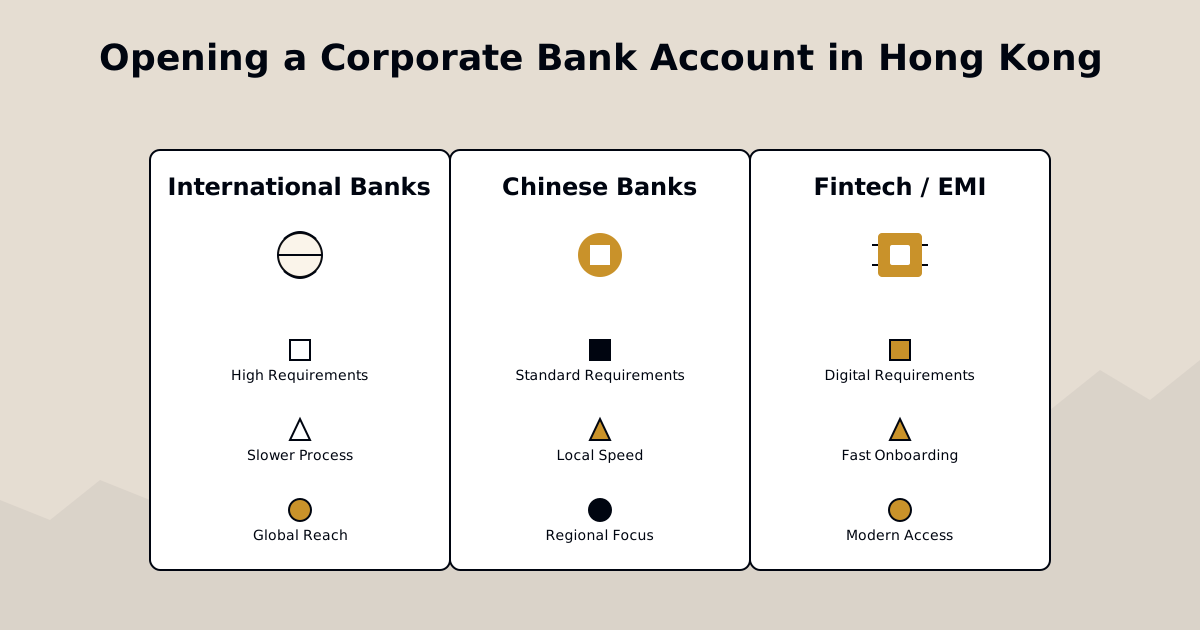
Hong Kong Bank Account for CIS Companies: 2026 Reality Check
Opening a corporate bank account is the most challenging bottleneck when registering a business in Hong Kong. While you can incorporate a company in just a couple of days, getting a functional bank account for founders from CIS countries (Russia, Kazakhstan, Kyrgyzstan, Uzbekistan) is a quest that requires meticulous preparation.
In this article, we'll give you a brutally honest look at the options available on the market in 2026, what they cost, and why traditional banks are increasingly losing ground to neobanks.
Why Do CIS Entrepreneurs Need a Hong Kong Account?
Hong Kong remains one of Asia's primary financial hubs. Having a local company and a bank account solves several problems at once:
- Seamless payments in USD, EUR, CNY. This is particularly relevant given sanctions constraints and difficulties with cross-border transfers from Russian and some CIS banks.
- Trading with China. Payments in Yuan (CNY/CNH) or Dollars to mainland China go through in a matter of hours.
- Neutral Jurisdiction. A Hong Kong company looks highly reputable to partners in Europe, the US, and Asia.
- No Exchange Controls. You can freely receive and transfer any amount of money.
Account Types: Corporate vs. Personal
Let's be clear from the start: opening a personal bank account in Hong Kong as a non-resident (without a residence permit or work visa) is practically impossible. The only exception is premium banking with deposits starting from $1-2 million.
Therefore, we are always talking about opening a corporate account for your Hong Kong Limited Company.
Option 1: Traditional Hong Kong Banks
HSBC, Hang Seng, Standard Chartered, DBS.
These are classic global banks with an impeccable reputation.
The Situation for CIS: Extremely difficult. Traditional banks have drastically tightened their compliance. For founders with Russian or Belarusian passports, the chances are close to zero due to sanctions risks (even if the business itself is not related to sanctioned goods). For citizens of Kazakhstan or Uzbekistan, the chances are higher, but the procedure is still grueling.
What they check (KYC):
- UBO (Ultimate Beneficial Owner): Passport, CV, proof of wealth.
- Source of Funds: Evidence of the legal origin of funds (bank statements, real estate/business sale agreements).
- Business Proof: Contracts, invoices, bills of lading proving that the business is real and already operating. Startups starting "from scratch" are almost always rejected.
Timeframe: 2–6 months. Visit: A personal visit to Hong Kong by the director is mandatory. Cost: Monthly maintenance of $50–200; they often require a minimum balance ($50,000+).
Option 2: Mainland Chinese Banks with HK Branches
Bank of China (Hong Kong), ICBC (Asia), China Construction Bank (Asia).
These are Chinese state-owned banks with full-fledged branches in Hong Kong.
The Situation for CIS: Noticeably more loyal than Western banks. They understand the specifics of trade between China and the CIS. Russian citizens can open an account here if the company deals with non-sanctioned goods.
Nuances:
- Compliance is still strict. You'll need a detailed business plan and proof of your connection to Asia (why do you need an account specifically here?).
- Often requires a personal visit to a branch in Hong Kong.
- The opening process can take 1-3 months.
Option 3: Digital Fintech Banks and EMIs
Airwallex, Currenxie, Statrys, ZA Bank.
EMIs (Electronic Money Institutions) and Virtual Banks are lifesavers for small and medium-sized businesses. They operate under regulatory licenses, your money is protected, and you can open an account completely remotely.
In 2026, over 80% of new CIS companies start their operations precisely with payment systems.
Popular Services:
Airwallex
- Pros: Excellent multi-currency service (they provide local details in the US, Europe, Hong Kong, Australia). Perfect for e-commerce, Amazon, Shopify. Cheap conversions.
- Cons: It's not always easy to pass KYC, especially if the business is related to crypto or "grey" goods.
Currenxie
- Pros: Focuses on B2B trade. Loyal to trade with China. Fast opening (often 3-7 days).
- Cons: Can sometimes have issues with incoming payments from non-sanctioned Russian banks (policies change frequently).
Statrys
- Pros: Human support, focus on Asian companies. Less strict requirements for startups. They issue corporate cards.
- Cons: Paid account opening and a monthly subscription fee (around 98 HKD/month).
ZA Bank (Virtual Bank)
- Pros: Full Hong Kong banking license. Deposit guarantee up to 500,000 HKD. More loyal than classic banks.
- Cons: Opening often requires physical presence (or at least being in HK to connect to local Wi-Fi when submitting the application).
Documents Required for Account Opening (Basic Package)
Regardless of where you apply, prepare:
- Statutory Documents:
- Certificate of Incorporation (CI)
- Business Registration Certificate (BRC)
- Articles of Association (NNC1 / NAR1)
- Personal Documents: Passports of all directors and shareholders (>10% stake).
- Proof of Address: A bank statement or utility bill in English, no older than 3 months.
- Business Proof:
- Business plan or detailed description of activities.
- Contracts with suppliers from China/Asia (letters of intent or already signed).
- Contracts with buyers.
- Bank statements of your main (e.g., Kazakhstani) company for the last 3-6 months.
Why Applications Get Rejected and What to Do
Common reasons for rejection:
- Weak Business Case: The bank doesn't understand why you need a Hong Kong account if you're exporting timber from Russia to Europe. There must be a clear link to Asia.
- Lack of History: You just registered the company and can't show a single contract or even a website.
- High-Risk Jurisdictions: Transactions involving sanctioned countries.
- Unsuitable Director: A nominee director with no relevant business experience.
What to do: Start with an EMI (Airwallex, Statrys). Build up 6-12 months of transaction history. With statements from a payment system, it will be exponentially easier to open an account in a traditional bank later.
Summary: Bank Comparison Table
| Criteria | Traditional (HSBC) | Chinese Branches (BOC) | Neobanks/EMIs (Airwallex, Statrys) |
|---|---|---|---|
| Timeframe | 2 - 6 months | 1 - 3 months | 3 - 14 days |
| Visit to HK | Mandatory | Almost always required | Completely remote |
| KYC Difficulty | Maximum | High | Medium |
| Maintenance | $50-200/mo | ~$20-50/mo | Free or $10-15/mo |
| Best For | Large corporate business | Trade with mainland China | Startups, SMEs, E-commerce |
Practical Tips from CISgate
- Don't get fixated on HSBC. In 2026, EMIs cover 95% of a trading business's needs: they are faster, cheaper, and have better interfaces.
- Contracts first, account second. Prepare draft contracts with Chinese factories. The bank needs to see paperwork.
- A website is mandatory. Even a simple English one-pager explaining the essence of the business significantly increases the chances of compliance approval.
Registering a company in Hong Kong and opening a bank account is our core specialization. We will analyze your business case and select the bank or payment system where the chance of approval is highest. Contact us for a consultation.